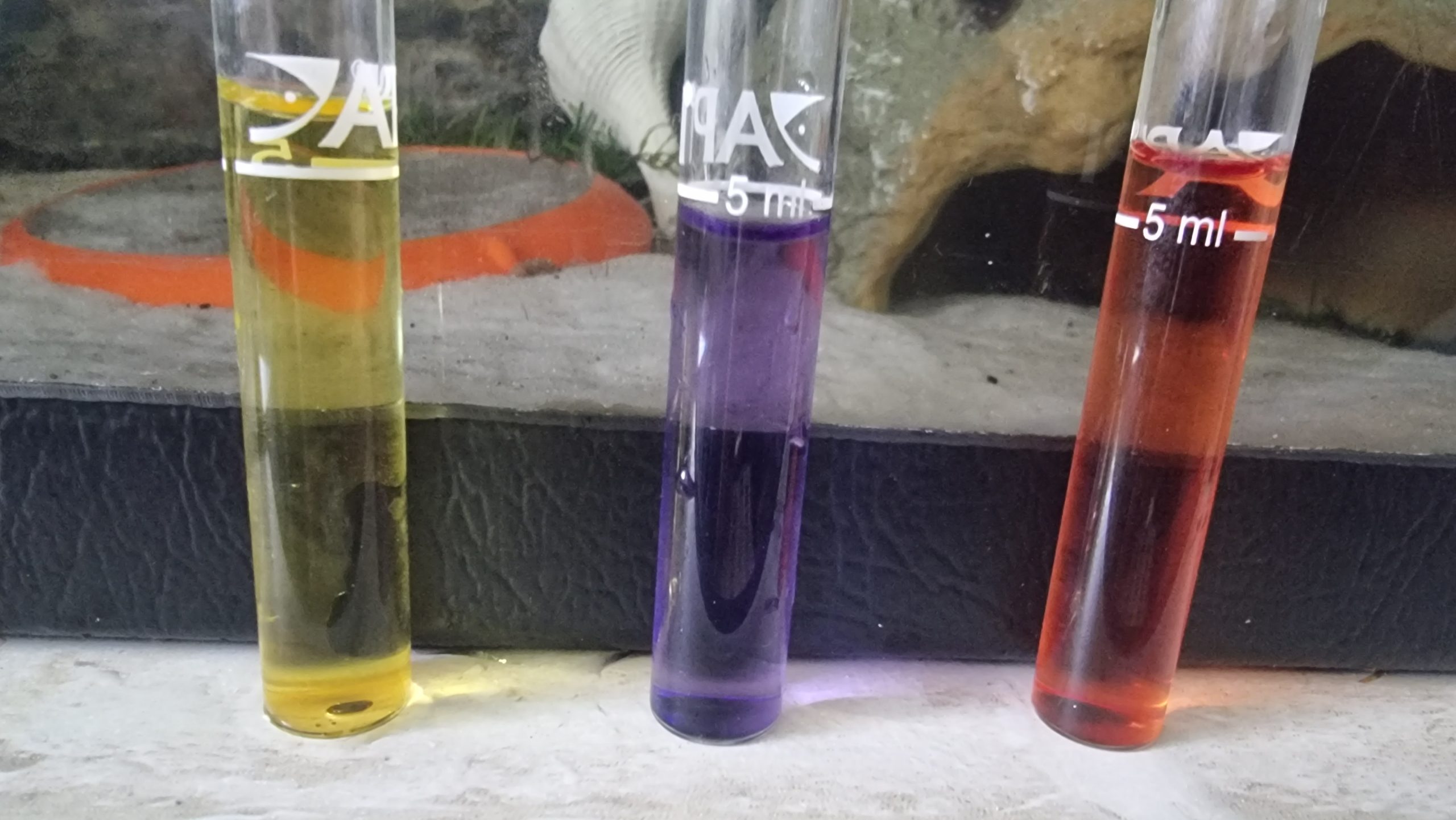
Why cycle a tank?
The most important thing you need to do for your axolotl is to cycle its tank before it goes in. This is crucial to having a happy and healthy axolotl. I know it’s really tempting to buy a tank and just add everything in on the first day, but I promise this will be worth it as your axolotl will be healthier and happier.
What does it mean to cycle a tank? Cycling a tank means creating a nitrogen cycle in your aquarium tank. This cycle removes the bad, while keeping the good. In order to complete the cycle, you will need to add the ammonia to match the amount that your axolotl will produce once they are in the tank.
What is the Nitrogen cycle?
As you can see from the diagram, once you add your axolot, they will produce waste, or drop some food. This will be converted into either NH3 or CO2. Both of these chemicals are bad for your axolotl if the concentration becomes too high in the water.
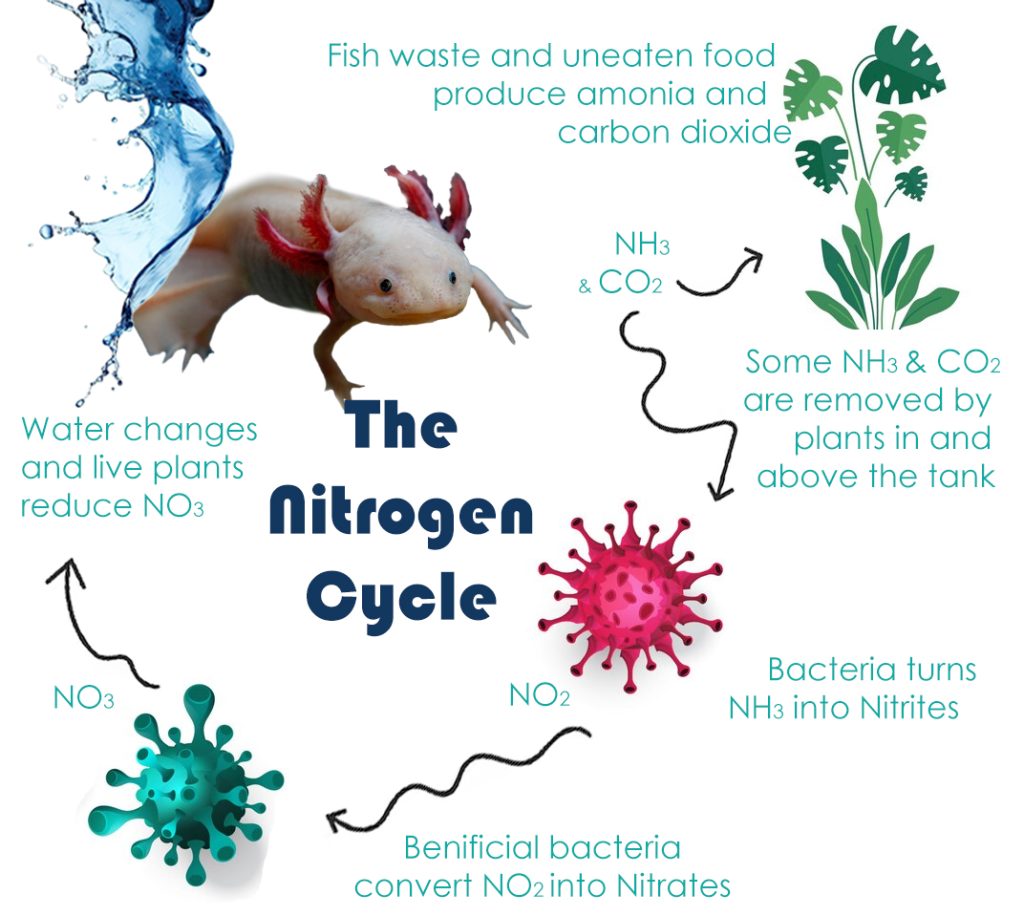
The nitrogen cycle eliminates these chemicals to keep the your axolotl healthy.
So, what do you do and what do you need?
– a tank
– a filter suitable to the water volume. (Remember to double it for your axolotl)
– water
– water conditioner (Seachem Prime is best)
– a source of ammonia (Dr Tims is popular, but there are other brands on the market too)
– bottled beneficial bacteria (Seachem Stability is best, be careful of others as
some contain aloe vera that will kill an axolotl)
– bonus item – if you are able to get beneficial bacteria from an established tank, you
will shorten the cycle process.
Now that you have your items, what next?
Before you add anything to your tank, get a cup of water from your tap and let it rest for a couple of hours. Then check the water parameters of your cup of water. (The API master test kit is the one I recommend. The test strips are not as accurate.)
This step is important to find out what your tap water is at when you start. Sometimes our tap water is totally off, and people spend a lot of time trying to balance a tank, only to find their water source is actually the issue. If your water is all neutral, you’re good to go, if not, try to source water elsewhere.
Next add your hardscape to the tank and play around with if for a couple of days to make sure you are happy. You don’t have to do this, but I find it easier to move the hardscape in an empty tank.
Once you are happy with your layout, add your water. Be sure to pour it onto a rock or something else to disperse the water or it will push everything around that you have put in place. Then add the correct quantity of water conditioner, ammonia and beneficial bacteria to your tank.
Every day, you will need to add the ammonia and the beneficial bacteria. The bacteria will only need to be added for the first week, but you will need to keep adding the ammonia source daily until the day before you add your axolotl.
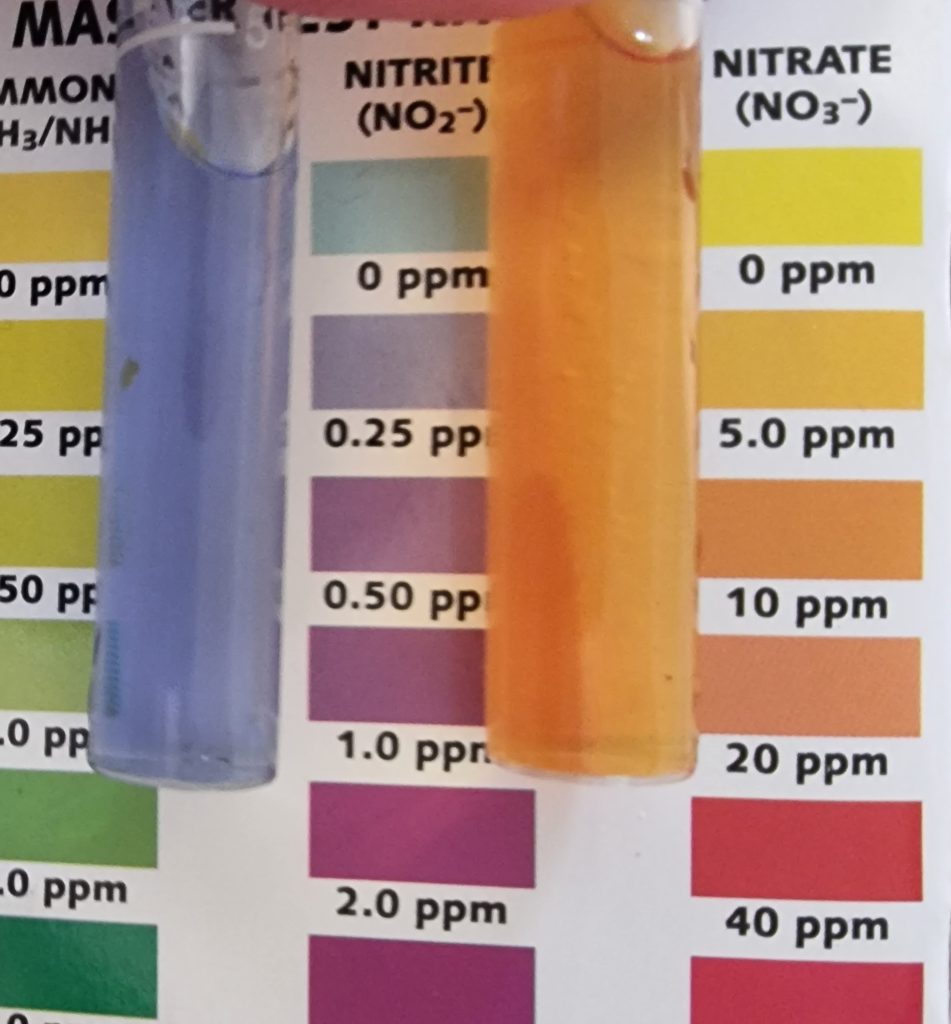
After a week, test your water. You should find that your ammonia and nitrites are very high, this is a very good sign. It means the process is starting to happen.
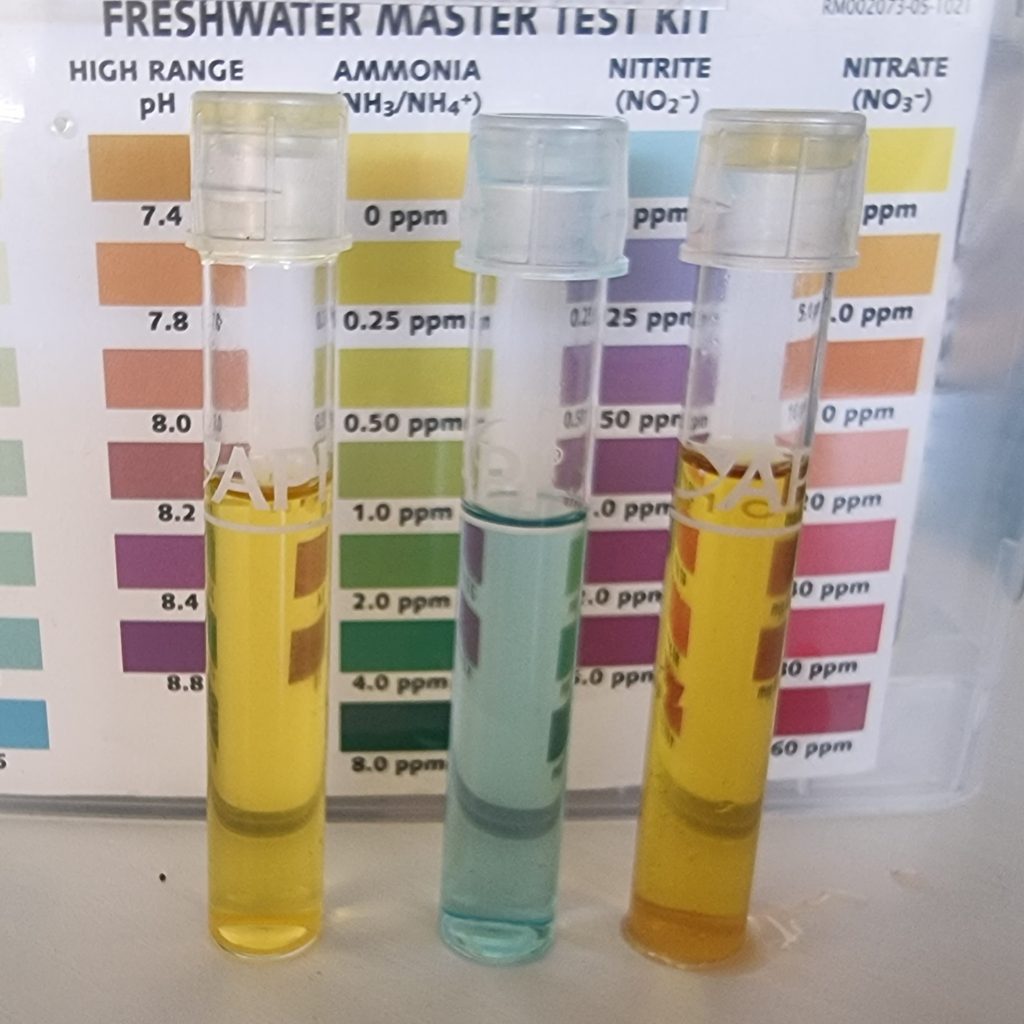
Keep checking your water every few days and adding ammonia daily and watch the process happen as the chemicals change from high ammonia and nitrites to zero ammonia and nitrites, with a little nitrates.
When the process is complete, you will be able to add ammonia to 4.0ppm and have your tests look like this after 24 hours, for 3 days in a row. This is known at the 3 day test. Once your tank passes the 3 day test, you are ready and can add your axolotl. However, its a good idea to continue checking the water daily for a week, before you move to weekly checks.
Your Nitrates may be too high at this point and need a 20% water changed to lower them.
Keeping your levels at Ammonia 0 Nitrite 0 and Nitrate 5 – 10 ppm is ideal for your axolotl. Once your tank is cycling correctly, you should see the Nitrates go up, but the Nitrites and Ammonia should stay zero.
After this point, sucking poop out as soon as you see it and doing about a 20% water change every week should keep your tank well maintained. Once a month, I recommend taking everything out, including your axolotl into a tub, and vacuuming the bottom for anything that you missed in your spot cleans. Take out the filter and scrape off any sludge in the water you have taken out the tank. Don’t change sponges or fully wash the filters as most of the benificial bacteria live there.
With the gentle spirit of axolotls,
Take care, I’ll see you soon.
Your Fairy Axomother